News
Digital experiences

Noosphere, coopetition, confederation: the XN Québec 2026 Summit and the challenges of Quebec’s digital creativity

Noosphere: when individual thoughts come together to form a superior collective intelligence.

Coopetition: collaboration between competitors to create value that no one could generate alone.

Confederation: an alliance of autonomous entities that choose to coordinate their strengths without losing their identity.

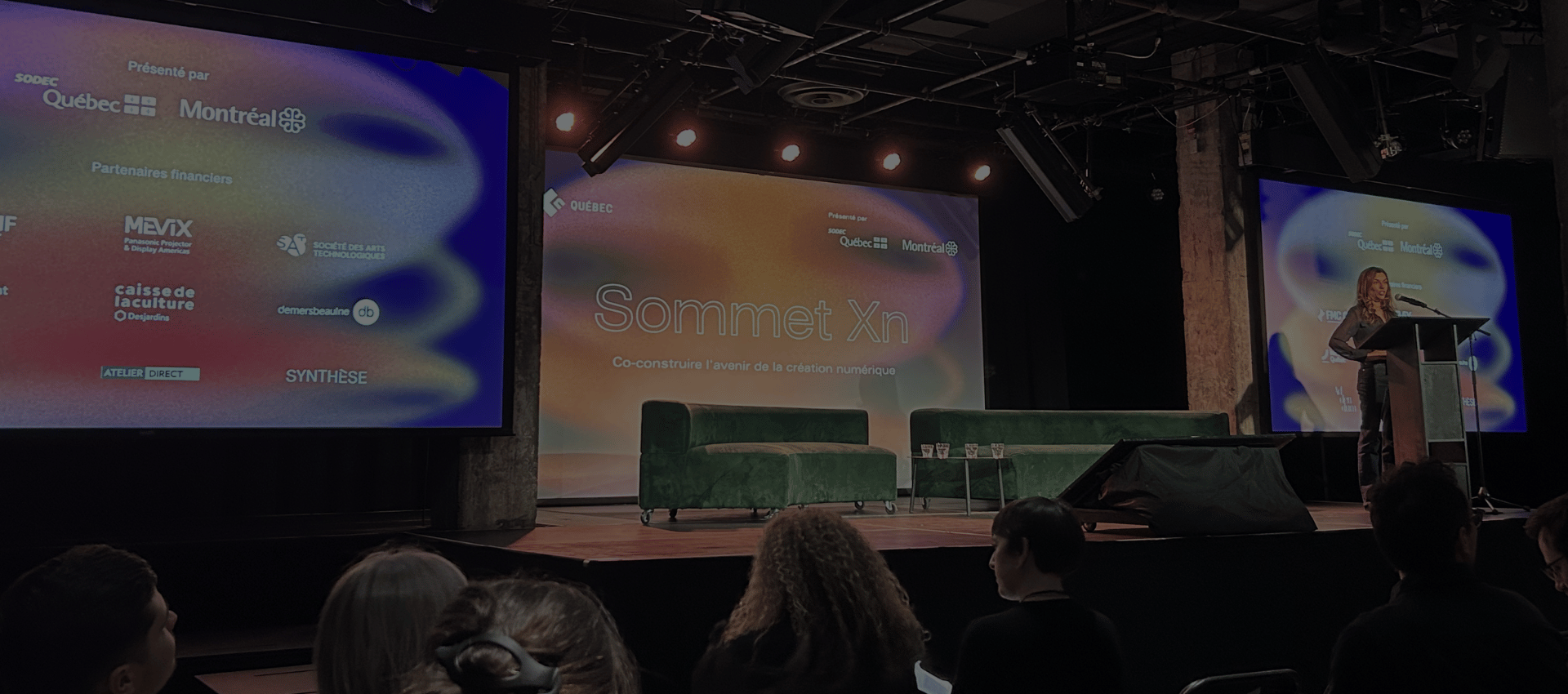
These three terms, rarely brought together in a single breath, characterize the uniqueness of Quebec’s digital creativity industry. They resonated in unison on February 5, 2026, during the XN Québec Summit held at the Society for Arts and Technology (SAT). XN Québec is a non-profit organization that brings together over two hundred member studios using technology as their raw material. Its mission is to promote the interests of the community of practice to government and strategic decision-makers, create partnerships, and establish conditions that foster the growth of the sector. In this spirit, the organization sought the participation of the ecosystem in developing its next strategic plan. Nearly two hundred people were present to reflect on the challenges ahead. The day revolved around three key themes: transformation, ambition, responsibility. The workshops for these themes were led by XN Québec’s partners: La SODEC, La Piscine MTL, , MUTEK, Centre Phi, SYNTHÈSE - Pôle Image Québec, la Société des Arts Technologiques (SAT).

This year’s summit took place in a particularly turbulent context: geopolitical instability, increased international competition, technological upheavals, and shrinking budgets and public funding. For an industry whose vitality depends on export and innovation, the urgency to collaborate was undeniable. Several issues surfaced in the day’s discussions. One example is the standardization of processes. In a sector where every project is unique, establishing common working methods without stifling creativity is a difficult equation to solve. Developing the next generation is also a major concern: attracting, training, and retaining talent in a constantly evolving environment requires greater coordination between universities and industry. Since the local market is limited, expanding internationally becomes essential for Quebec’s visibility. Finally, responsibility touches on the ecological footprint of an energy-intensive industry. Eco-responsibility should be understood not only as a value but as a strategic lever and brand identity, with performance indicators aligned with international standards. It also concerns the ethical framing of AI, accessibility, and transparency.

Crédit photo : Maryse Boyce

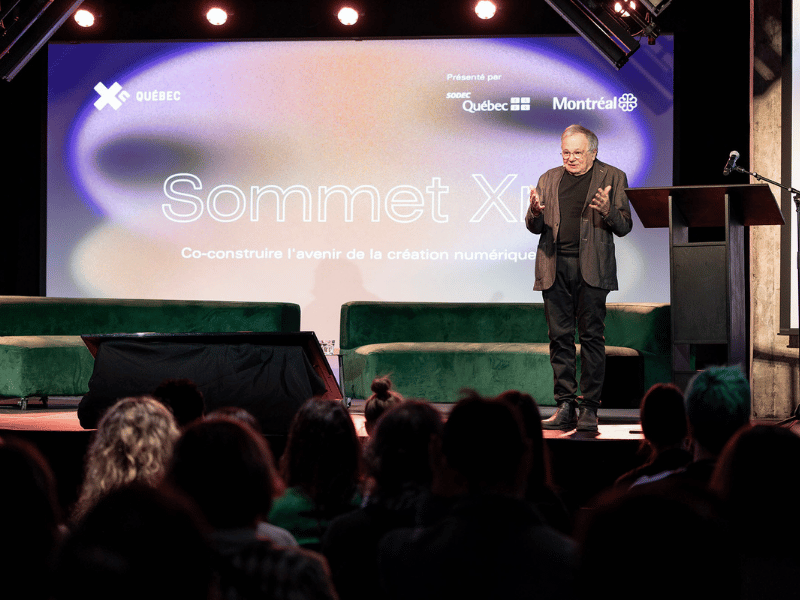
The guest of honor for the opening keynote was Jean-Jacques Stréliski. A veteran of Quebec marketing, Stréliski has trained nearly three decades of students. He humorously introduced himself as “the grandpa of the industry.” A grandpa who shares human truths because he knows the realities of life and business, having experienced them through both successes and disputes.

Stréliski’s words set the tone. Quebec’s digital creativity industry, although relatively young, already has an international presence. This recent past is a motivating force: the memory of what was done, and how it was done, can be reproduced regardless of evolving circumstances. The challenges of geopolitical instability, global competition, or the introduction of generative Artificial Intelligence—however intense—are not without precedent: they recall the uncertainty Internet provoked in the early 2000s.

The hardest part is done. Quebec has made its mark. But what is a brand, Stréliski reminds us? A brand is above all an act of communication: to talk about a brand is to talk about a company’s values and embody them. A brand is created in the mind and ear of others—Stréliski borrows here from Arthur Miller and Milan Kundera. And this requires stepping out of one’s corner, confronting, negotiating, adjusting. Producing without communicating results is what Dominique Wolton calls incommunication. Real communication involves the possibility of failure, misunderstanding, and negotiation for alignment.

A brand is a reducer of uncertainty, he says, borrowing the expression from an HEC professor. Technology is a precious tool to be used wisely, in service of what matters: telling stories and offering emotions. And happiness lies in returning to the basics of the merchant’s trade—doing business face-to-face, in the street, not behind a computer. The Quebec brand is the embodiment of simplicity, sincerity, responsibility, and courage. All that remains is to continue doing what has already been started.

Crédit photo : Maryse Boyce

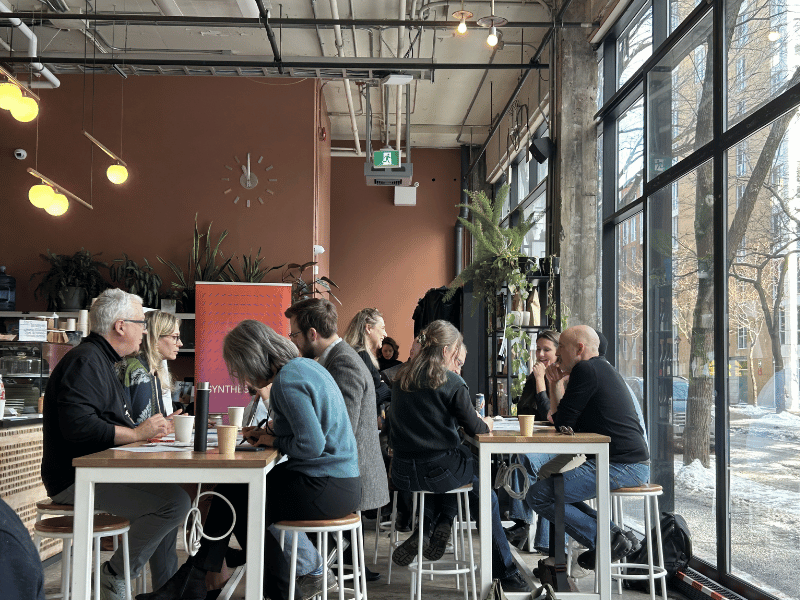
The day combined panels where industry actors shared their experiences, followed by workshops in which participants formulated proposals.

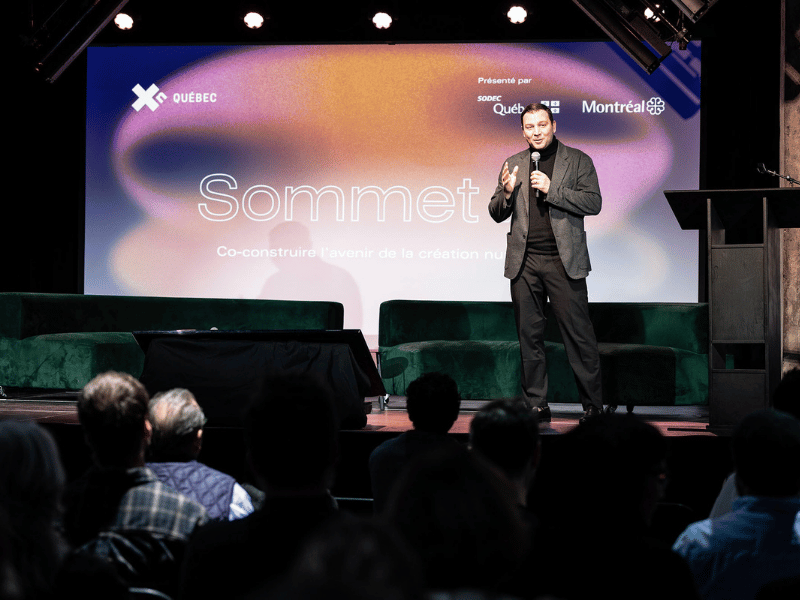
As part of the transformation theme, several actors discussed the structuring processes within their organizations. Véronique Paradis, Director of Innovation and Training at the SAT, shared the institution’s journey. After thirty years, the SAT evolved from a performance venue into a school offering courses, a research center developing open-source software, and an artist residency space. The SAT now produces nearly three hundred events per year. Nicolas Roy, President and Executive Creative Director at DPT, explained how responding to a major international contract required the company to evolve from about fifteen employees in a horizontal structure to a hierarchical organization. Émilie Guertin, Executive Director of the BANQ Foundation, presented the Labo, a free, creative and digital innovation hub accessible onsite and online throughout Quebec. Inspired by the MIT model, the Labo combines a FabLab and a MediaLab designed to lower technological barriers in a spirit of sharing and open access. Denys Lavigne, President and Co-founder of Oasis Immersion, discussed the challenge of remaining agile amid the growing hybridity of immersive productions. Cathy Vezina, professor at UQAT, mentioned the need to revise university programs to reduce the gap between graduates and the real needs of the industry.

Several ideas emerged from the discussions. Creating hybrid-role positions to bridge departments. Relying on external consulting support during restructurations and, when growth accelerates, implementing a dedicated human resources role. Opening the industry more to new graduates—in projects and in professional events—remains both a challenge and an opportunity for both parties. The will exists, but production pressures leave little time for the care and patience required for knowledge transfer. The question is not whether to integrate beginners, but how to do so starting from the conception phase.

The workshops followed the themes addressed in the panels. Participants were asked to imagine headlines that would put Quebec on the front page in 2030, or to propose forward-looking projects that XN Québec could include in its strategic plan in areas such as resource sharing, advocacy, mobilization, or promotion. Many concrete proposals emerged. Studios could make their spaces and equipment available for independent projects—a contribution that could be counted as tax credits, for example. Another idea was to establish a provincial project in which the Canada Media Fund and SODEC would subsidize the Université du Québec network in all its regional campuses, enabling students and professors to produce practical content for museums under the Société des musées. These contents would circulate and be exhibited in regional museums. This business model could be exportable internationally.
Crédit photo : Maryse Boyce

The day concluded with a series of live questions submitted to participants via QR code (4). The responses were overwhelmingly positive; a confidence rating of 8 out of 10 had already been recorded at the start of the day. Only one question divided the room: the integration of AI into work processes, approved by about fifty percent. This result is perhaps the most revealing of the day—not as a sign of resistance, but of lucidity. An industry that shows 8 out of 10 confidence yet hesitates about AI is not afraid: it is measuring. As Brené Brown (5) says, if the nervous system is not equipped to face so much uncertainty, good leadership recognizes the situation, breathes, stabilizes, observes, and then builds collective strength. In noosphere, coopetition, and confederation.

With this event, XN Québec illustrated its mandate: bringing the ecosystem together, creating conditions for its growth, and opening doors to decision-making and strategic bodies. The Minister of Culture and Communications, Mathieu Lacombe, and Alexandre Teodoresco concluded the day. Teodoresco, now Montreal city councillor responsible for artificial intelligence on the executive committee, fondly recalled his seven years with Les Sept Doigts de la main. He is also a bridge—someone who knows the industry from the inside and now sits where decisions are made. His path reminds us that although policy development is slower than technological upheaval, the creative industry must have a seat at the table where the future of AI is decided—alongside engineers, ethicists, and educators. The question is not to endure choices, but to shape them. One simply needs to follow the recommendations of specialists who, from Fei-Fei Li to Yoshua Bengio, from Joy Buolamwini to Karen Hao, and from S. Craig Watkins to Emad Mostaque, are already thinking about these issues.

--

 (1) Arthur Miller, Death of a Salesman, 1949. Stréliski recounts that Miller had initially titled the play The Inside of His Head. His producer convinced him to change the title.

(2) Milan Kundera, The Book of Laughter and Forgetting, Gallimard, 1979. “A man’s entire life among his fellow human beings is nothing other than a struggle to seize the ear of others.”

(3) Dominique Wolton, Informing Is Not Communicating, CNRS Éditions, 2009.

(4) Real-time questionnaire submitted during the summit: https://audience.ahaslides.com/6e6wh6vvmx

(5) Brené Brown, Dare to Lead: Brave Work, Tough Conversations, Whole Hearts, Random House, 2018
Learn more about Shirin Abu Shaqra
Share

Follow us

Privacy Policy
emailSubscribe to our newsletter